SIP
This is a challenging moment. The data center industry is racing to meet demand for compute. The power industry is racing to meet demand for electricity. And politicians, citizens, and consumers are trying to wrap their arms around rising costs, changing communities, and their own growing use of AI. Infrastructure builders are working to solve several difficult problems at once: massively expand the grid, as fast as possible, without raising prices or harming the places where the necessary infrastructure gets built.
Sidewalk Infrastructure Partners (SIP) has been investing at this nexus of technology and power longer than most, and we have learned a thing or two about how to meet this moment.
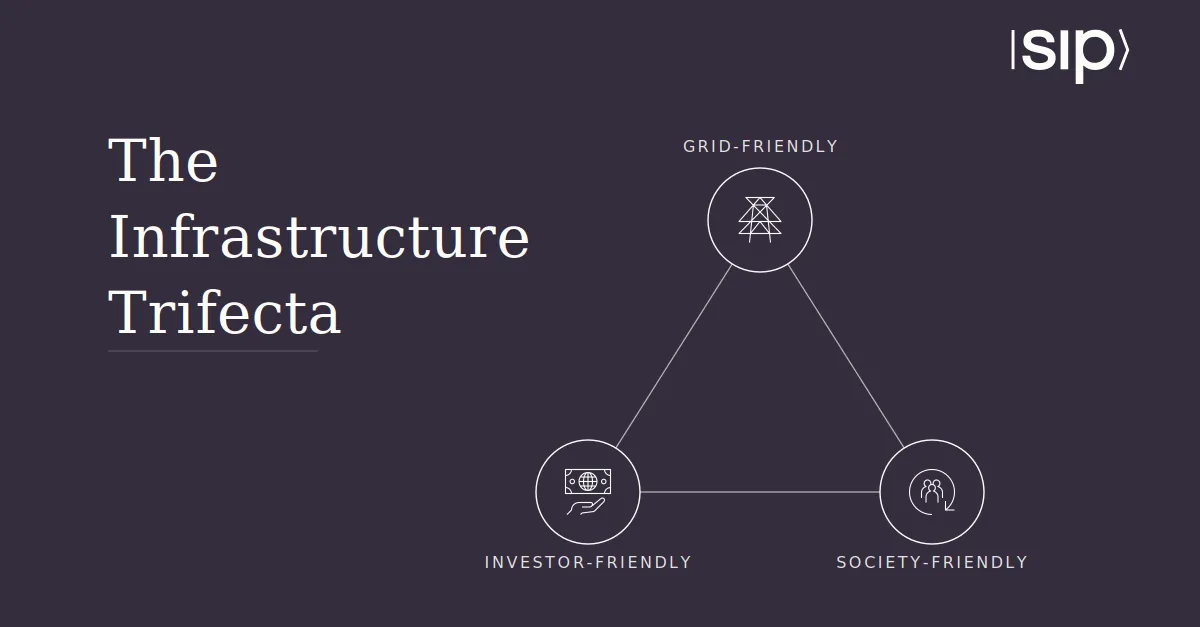
We have seen how successful infrastructure efforts—whether a company, a project, or a technology—depend on solving for three elements, and none of them are optional:
Without all three, projects stumble. A gas peaker plant may be grid-friendly (because it adds capacity) and investable, but it is not contributory—it raises costs, pollutes, and becomes a community liability. By contrast, a solar farm might be contributory and grid-friendly, thanks to its clean electrons, but it may not be investable without subsidies. And in an era of lengthy interconnection queues, an inflexible data center that is not an asset to the grid risks not receiving power at all.
Within the energy space, none of the three is especially challenging on its own. The difficulty—and the opportunity—is satisfying all at once. Every durable value proposition must begin by considering the benefits not only to the customer and the investor, but also to society—whether in the project’s backyard or the planet writ large. No doubt it is possible to get rich quick with infrastructure that extracts more than it contributes. But that will not be durable infrastructure.
The challenge of developing companies and projects that clear this trifecta is especially visible with data centers. Today, the winners appear to be companies that can supply and secure power in any form, at any cost, as quickly as possible. But this rush risks alienating host communities. We see the growing political pushback, local moratoria, and developers stepping back from sites where the dynamics feel wrong. In the first quarter of this year alone, at least twenty proposed data centers were canceled following local opposition, representing more than $40 billion in investment and 3.5 gigawatts of demand, according to Heatmap Pro. The tailwinds of an unprecedented industry boom are being met by the headwinds of unprecedented public opposition.
Solving the trifecta is crucial in meeting this challenge. We know that today—and certainly in the long term—data center tenants want more flexibility, more sustainability, and a smaller resource footprint. Those same attributes serve communities as well. Flexible data centers function as assets to the grid, helping to lower prices by driving revenue to their utility while minimizing the risk of stranded generation or transmission assets. Of course, they also grow the local tax base, drive economic development, and serve the compute needs of their customers. These are durable benefits. Facilities being built without them will be like Class B office buildings, still functional but always losing value. At SIP, we recognize that short-term conditions and long-term discipline are not in tension, but reinforce each other.
Finding true and lasting benefit is a gating item now, but it was a founding principle of SIP’s mission. What is glaringly evident today is how an inattention to the third piece (being society-friendly) has become a critical liability. We have seen, again and again, how difficult it is to solve the first two problems—to build projects that pencil out and serve the grid—and then try to bolt on a societal benefit after the fact. That approach does not hold. We have no interest in building anything that does not inherently serve our investors, our partners, and our society—and is therefore not built to last.
You can see evidence of this in our companies. Renew Home is the trifecta in action. Its platform shifts household temperatures to save energy; passes the savings back to residential customers; offers six gigawatts of dispatchable capacity to utilities; and ultimately delivers very attractive investor returns. The community benefit is baked into the business model.
Verrus embodies the same principles at hyperscale. Its data center flexibility stack was built in the sustainability era, before LLMs changed the calculus. But the same technology that enables Verrus data centers to adapt their usage to draw from clean energy sources, also lets them step down when the grid is overloaded, reducing strain on the system and lowering costs for customers. That flexibility speeds time to deployment, meeting the massive commercial demand for compute and further improving investor returns.
Infrastructure is the platform upon which everything else depends, and it has to be dynamic and flexible. Otherwise, it will not fulfill its lifespan but instead become an albatross around a community's neck. The challenges of the current climate affirm our longstanding approach. Since our founding, we have stuck with the macro themes and moved aggressively when something solves the trifecta. We stay focused on the long arc rather than the current cycle. We lean into innovative solutions when others hesitate. We know that discipline creates optionality.
The platforms built to meet this moment—built to contribute rather than to extract, and built to serve not only investors but also the grid and our society—will be the assets that last.